Sunday, 12 May 2019

Easter 2019 at 'The Lake' (near Quilpie, QLD)

Our wake-up cups of coffee in hand we enjoyed the dawn watching the stars fade as darkness transitioned to yet another sunny blue sky day in outback Queensland - you can’t really get tired of it!

With a gentle tailwind behind us all the way we travelled, achieving excellent fuel economy, ~ 200 kilometres due W from Charleville to our next destination.

Small blue & white sign against a similar background can be hard to see
when driving down the highway.
Lucky they also have a bright orange caravan parked by the gate.
You can't miss it!

‘The Lake’ campground is located on a working sheep and cattle station just 4 km E of the town of Quilpie (pop~ 650).  It caters to any style of campers ranging from caravaners wanting to park adjacent to the station house ‘Caravan Park style’ with connections to power & water with nearby showers and toilets, through to those that simply want to ‘bush camp’ and pitch their tent (or caravan in our case) away from station facilities beside the lake.  Being ‘fully self-contained’, i.e.: our van carries it's own power (solar and battery system), water and toilet facilities, we chose an option that lay between the two book-ends and proceeded to set-up a nicely private camp (just us, the cockatoos at sunset, and the flies (all daylight hours)) on the lakeshore a couple of hundred metres away from the homestead.

We had a great campsite beside the lake

Once we had made camp and unhitched the vehicle we drove straight into Quilpie to fill up the fuel tank and pick up some minor provisions (hot-crossed buns and chocolate - it is Easter after all!), before everything closed down for the long weekend (a typical occurrence in small towns on holiday weekends).  As it turned out, there was no need to worry as there were two or three 24hr card-lock Fuel Depots used by long-haul truckers to choose from that never close down.

Being the Thursday before Easter and a lovely spot by the lake secured, we decided we would settle in and stay for 3 or 4 days.  Being off of the roads during the long-weekend is generally a good idea too - not that it is very busy way out here over 1,000km from the nearest city!

As soon as we had returned to camp, out came the metal detector!  Within seconds of starting her hunt Heather was cursing the flies.  A minute or two later and she was back in the caravan to get her ‘bug-hood’ so that she could: a) see, and b) breathe without inhaling any of them!  Not long after donning her hood a cry of joy as she had made a find!  It was a Sterling Silver (92.5% Ag), Three Pence coin!  Who would have thought there would be something to be found less than 20 m from our campsite?!

H in bug-hood found this 1943 Three Pence coin
just metres from the van.


On Good Friday, our camp hosts at The Lake, Sally and Mike, invited everyone on site (about 4 couples and 2 families) to join them around the homestead camp fire for a Sundowner (BYO beverage of your choice as the sun goes down) and some ‘Sun-dried Tomato and Olive’ damper.  

Arriving about 30 minutes before the sun went down, we (and everyone else), were accompanied by our ever-present entourages of flies.  It is tough to enjoy a drink while wearing a fly hood and hard to conduct a conversation without, so we reverted to chemical warfare!  Liberal application of ‘Aeroguard’ kept the little blighters at bay until, with the arrival of darkness, some natural relief arrived and they (the flies) just go away!  They must be scared of the dark!

Don't forget the Aeroguard and 'Avagood Weekend'

The respite that comes with the setting of the sun and the subsequent departure of the flies, is however, unfortunately brief.  In what could be considered a cruel quirk of nature for living things out here, the annoying flies are no sooner gone than they are duly replaced by a ‘nightshift’ of peskie mosquitoes!

When camping by water it has never been truer that you need to make sure that you ‘Don’t forget the Aeorguard’ in order to ‘Avagood Weekend!’.  All Aussies will know exactly what I am talking about here as the two phrases above are a reference to some classic advertising for bug spray from their younger days and childhoods.  The ads are now part of Australian popular culture. 

OK, after that little tirade against bugs trying to make their living from our blood, sweat, & given enough persistence on their behalf, maybe, tears, I must say that the Sun-dried Tomato and Olive damper was delicious!  We enjoyed it so much that I asked Sally for the recipe which she was good enough to provide.  I will be giving this a go in the camp oven myself at some point in the future and will let you know how it turns out - might even make a video of the event!

In just two days and nights at The Lake we had almost emptied the can of Aeroguard that we had on board when we arrived so we made a stop at about the only store in Quilpie that was open on the weekend to get some more.  With ‘bug security’ reinforcement now in hand, for our entertainment on Saturday we drove, sans caravan, about 100 km out to the town of Adavale as this was the location of the Adavale Pub to obtain the next signature in our Bush Pubs book.

The Adavale Pub, is listed 1st in our Aussie Bush Pubs book
for no other reason than it's name begins with the letter 'A'

Our visit to the pub made for a pleasant outing.

We had a good chat with the publican, Koss, who, over a beer, and along with his signature, provided us with a bit of history about the area.  He also told us that a book, titled ‘Kings in Grass Castles’ written by Dame Mary Durack and made into a TV mini-series, is about The Durack Family and how they first established a large land holding in the area. 

Heather with Publican 'Koss'
He is the 17th publican to have signed our book (so far).

Sunday was a lazy day back at the Station.  As we took refuge from the flies in our van we decided to watch the mini-series we were told about the previous day (good 4G network service allowed us to watch via YouTube).  It was entertaining and a little disturbing in parts but we also learned a bit more about some of Australia’s pastoral history too.

All of the chat around the campfire that evening was all about the weather and the forecast of up to 75mm (3 inches) of rain for the district across Monday and Tuesday.  Given the fact that Queensland ‘black soils’, unaccustomed to moisture that they are, get as slippery as clay (because that is essentially what they are), after just a couple of mm of rain, we resolved to be gone by 10am on Monday before it was forecast to arrive.

We were settling up our camping fees under cloudy skies and on dry ground with our hosts around 7am on Monday morning when somebody mentioned metal detecting and somebody else (hello Sally), let slip that ‘in the old days there used to be Chinese garden patches on the other side of the lake’.  Too tempting an opportunity to resist for a Metal Detector, rather than hitch-up the caravan right away, we drove about 4km by road and then across a paddock to get to the bank on the other side of the lake (despite it being just 200m ‘as the crow flies’) directly across from our caravan, in order to ‘take a swing’ for an hour or so.

This time, wearing her fly-hood from the outset, Heather once again struck ‘pay-dirt’ almost immediately at the base of an old tree near the water’s edge.  Two coins in the one hole!  A 1949 Kangaroo Penny and a 1942 Kangaroo Half Penny.  

With bug-hood in place, Heather found two coins in one hole!
Above L) 1949 Kangaroo Penny, and R) 1942 Kangaroo Half Penny 

Then the fun really started… No sooner had we identified the coins than the first drops of rain started to fall.  We scrambled back to the car and by the time we had got into it the rain was coming down heavily.  We immediately set off back to camp.  Despite the rain having stopped after just a couple of minutes, already the tread on the tyres of the ute were caked slick with slippery mud making it difficult to steer.
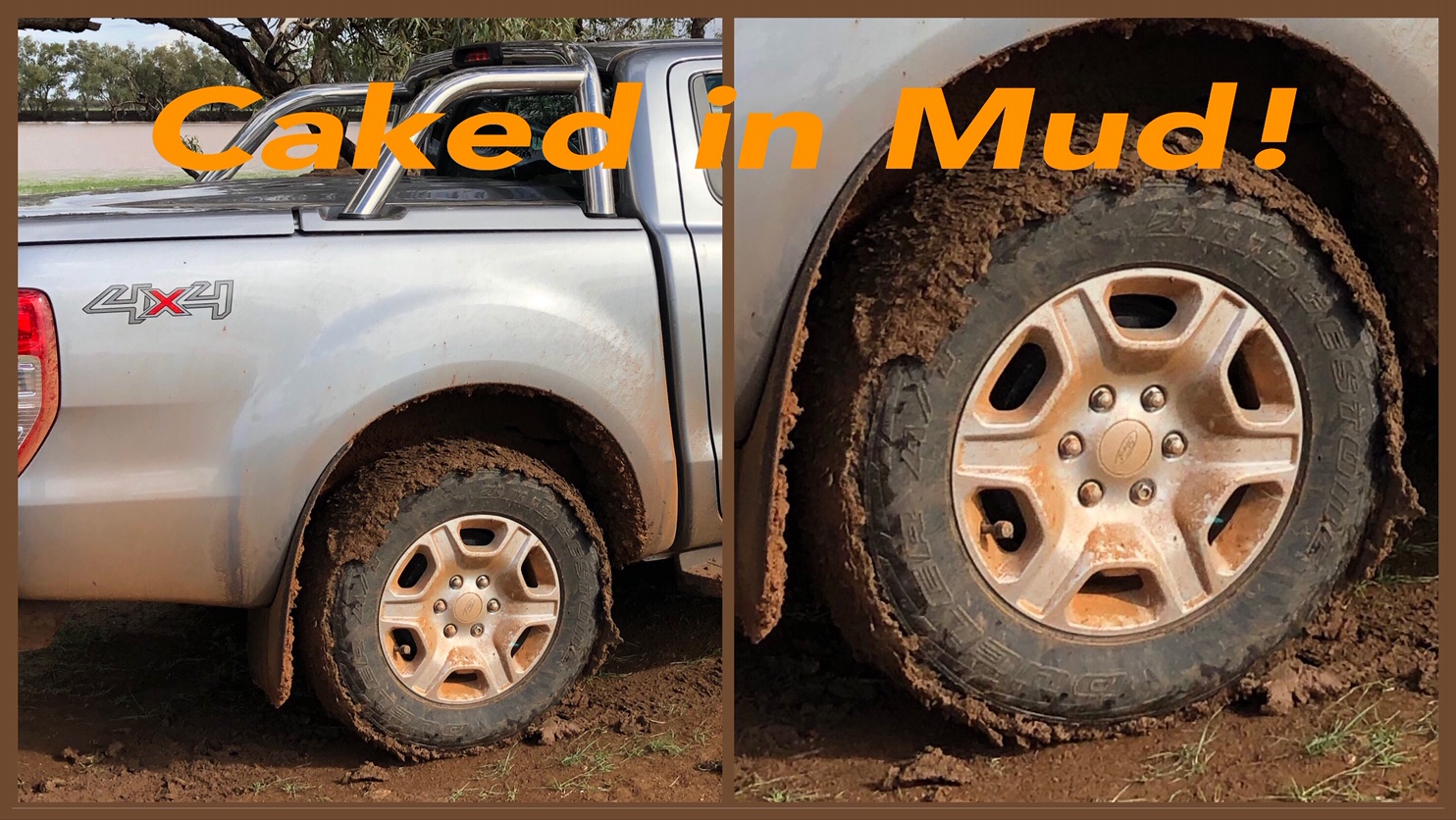
Mud quickly turned the chunky tread on our tyres into smooth slicks!

Back at the van, we got taller with every step we took just moving around getting ready to try and leave.  A couple of minutes of rain, dropping 2 or 3mm at most, had turned our campsite and the track into, and more importantly out of it, into a greasy clay slick.

The track into and out of our campsite had
become a greasy slick in just minutes!

Seeing what a mess a couple of mm of rain could make of the tracks, experiencing the lack of traction available to a vehicle on the wet clays, and with forecasters predicting over 25mm more rain to start falling within the next hour or two, WTF? - Where are The Farrows? needed to GTF! - Get The Farrows! outa there ASAP before the rain really arrived!  If we couldn’t move to higher ground we would be stuck (literally) for days (again, literally!).

I openly admit that I was not sure if the ute would be able to gain enough traction to tow the van up the clay laden slope.  We took some time, but not too much time (because it was soon going to start raining again), planning our way out.  
The time had come to act.  After letting air out of the tyres to improve traction, down to 20psi all around - ute & van, I selected Low Range 4WD to tow the 3 tonne van to higher and drier ground.  As it turned out the ute pulled the combination out without much drama but we couldn't have done it so easily without lowering the tyre pressure first.  I was very relieved!  Now parked safely on high ground we re-inflated to correct pressures for the highway and down the road we went with dark clouds looming.

Next stop for WTF? - Where are The Farrows? was to be the South West Hotel in Toompine - the next of the classic outback pubs on our Bush Pub Crawl!  Was it a regulation 'stop, sign & and go' or did the rain cause a change in plan?

Thursday, 9 May 2019

A Fence, A Couple of Pubs, A Diprotodon & the Cunnamulla Fella

After a three day pause to allow water flowing over a road crossing to subside we resumed our journey only to arrive at the border between NSW and QLD to find a fence and a closed 6ft high gate separating the two states.  I thought walls and fences between jurisdictions were an Iron Curtain era or Donald Trump kind of thing!

Welcome to Queensland
(and don't forget to close the gate behind you!)
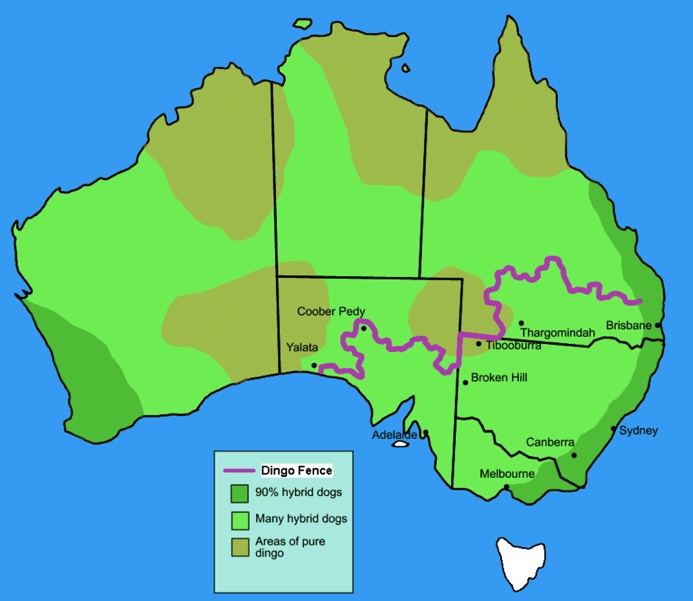
As it happens, this fence and gate was in place well before the Berlin Wall was erected.  In fact, it was installed in the 1880’s as a ‘Pest Exclusion Fence’.  The pests to be excluded being dingos, dogs and rabbits, which posed a threat to flocks of sheep found in the relatively fertile south-east of the continent.  It is one of the longest structures in the world stretching 5,164 km from the Darling Downs in Queensland to the coastal cliffs of the Nullarbor Plain west of South Australia’s Eyre Peninsula.

The fence stretches over 5,100km

Today, the gate still needs to be opened and closed by everyone passing through it.  Apparently there is a penalty of $1,000 for failing to close the gate, though I don’t know who would police it as the publican at the Hungerford Hotel, located about 100 m ‘inside the gate’, was the only living soul we saw while we were in town!

The Hungerford Hotel (established 1874), is officially licensed as The Royal Mail Hotel, and was once patronised by famous Australian Bush Poet, Henry Lawson, in the summer of 1892/93 during his trek (on-foot) between Bourke in NSW and Thargominda in QLD along the Dowling Track.

Royal Mail Hotel, Hungerford (est 1874)

When we dropped in we had a beer and a chat with the publican and made a donation to the Royal Flying Doctor Service (RFDS).  The process is unique to bush pubs...

The donation is made by pushing a drawing pin or thumb tack through the centre of a bank note, folding the rest of the note back on itself and around a couple of heavier coins to give the assembly some weight, then throwing the projectile upwards towards the ceiling of the bar.  If the pin sticks the note to the ceiling, your donation has successfully been made!  If the note does not get pinned to the ceiling and floats back to the floor, it is forfeited and can be considered to be 'the price of failure' and deposited into an RFDS donation can placed on the bar.  I am quite proud to let you all know that I managed to get the note to stick on my first attempt!

I managed to make my donation to the RFDS 'stick'

After making our donation, the publican, Graham, duly autographed his page making it the 15th of 51 Bush Pubs in our book to be signed.

15 down, 36 to go!

Apparently Henry Lawson was not impressed by his visit to Hungerford (not necessarily the pub but the town) and later wrote:

‘Next morning we rolled up our swags and left Hungerford to the North-West’.

Although we had more fun than Henry during our visit, we too left Hungerford to the North-West shortly after completing our mission.

After overnighting at a bush camp at 10 Mile Bore, located (unsuprisingly), a distance of 10 miles NW of Hungerford, we got back on the road, now heading north east, and made a quick pit-stop in the town of Eulo.  Eulo’s claims to fame include: Artesian Mud-Baths (we did not partake) and, having been home to the ‘largest known marsupial to have ever lived’.  The beast in question was a Diprotodon (meaning “two forward teeth”), and was a member of a group of species collectively known as 'Australian Megafauna'.  They were the size of a hippopotamus.  The closest surviving relative is the wombat.

'Diprotodon' is a distant (in time) relative of the Wombat

The next town we rolled into 70 km to the east was Cunnamulla.

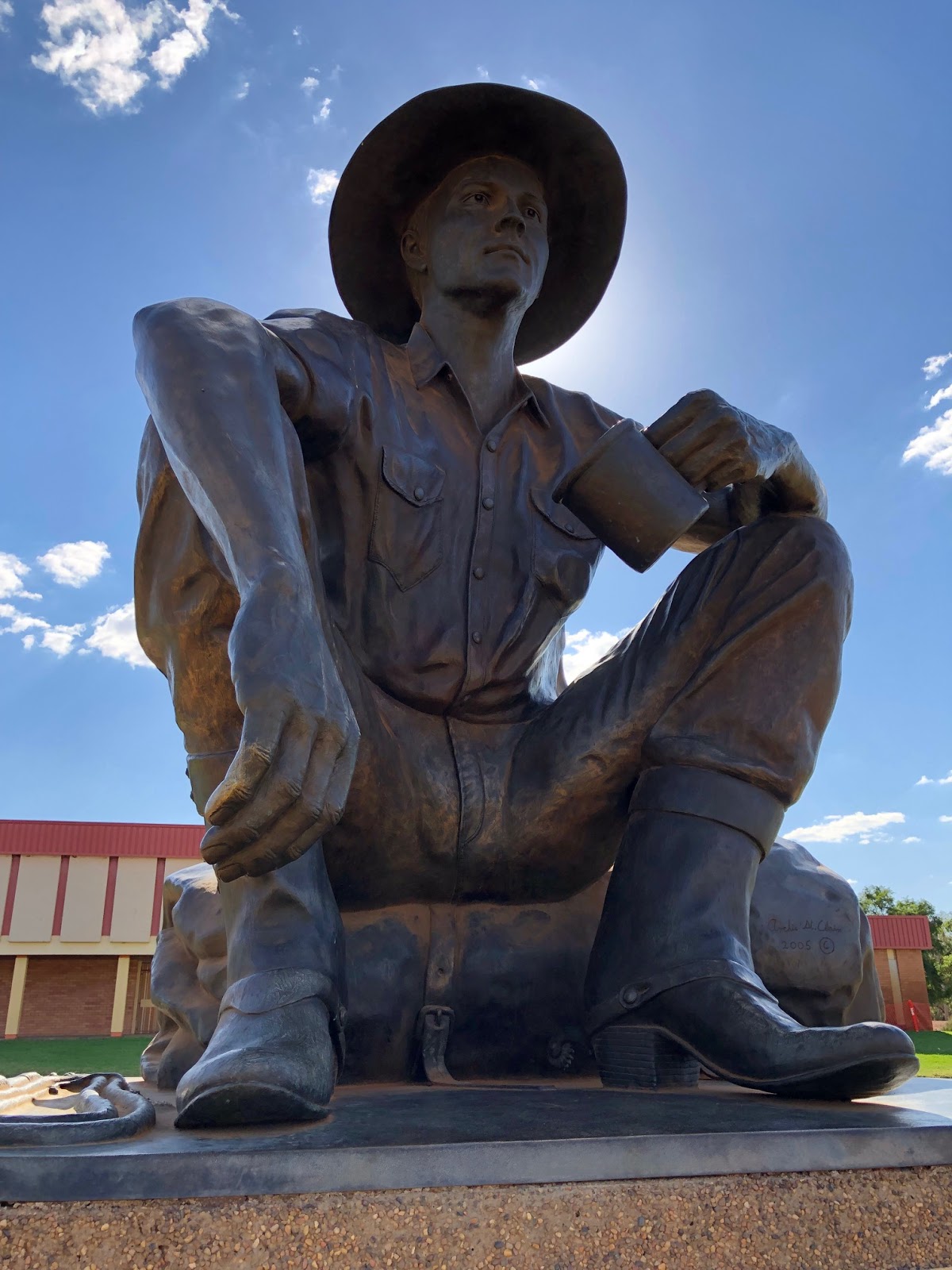
In Cunnamulla there is a twice life-size bronze statue of a stockman squatting on his bed-roll (swag) known as the 'Cunnamulla Fella'.  It stands as a tribute to the young sheep and cattle station hands (and all hardworking stockmen), that have worked in the district since the 1860’s.  These young fellows, many only 15 or 16 years old, worked long hard hours from sun up to sun down often 7 days a week mustering sheep, chasing ‘scrubbers’ (a scrub bull that had escaped castration early on in life that then grows up to be mean and rebellious), and breaking-in horses.  In the boom days of the 1950’s and 60’s, large properties (hundreds of thousands of acres) employed many men.  When they came to town the pubs would overflow and groups of these young 'fellas' could be seen squatting around the streets in the classical pose.

The 'Cunnamulla Fella' in typical squatting pose

I was surprised by how large 'twice life-size' is.  To provide a sense of scale for you, please see the photograph of me and 'my big mate' below.

This fella is a big unit!

Saying goodbye to the Cunnamulla Fella we headed north out of Cunnamulla towards the next pub along our route - The Gladstone Hotel in the sleepy town of Wyandra.  I think you know the drill by now:  Introductions, have a chat, have a beer, take some photos of the pub, obtain publican’s signature (#16 in this case), move on to next camp site.

All smiles at the Gladstone Hotel in Wyandra, QLD.

Now well and truly into our pub crawl route, the next few pubs would take us a couple of hundred km out west, then a couple of hundred south, then a couple of hundred west again, then north a bit, then east, then… WTF? - Where are The Farrows? are getting dizzy just thinking about it!

It was time to take a break for Easter.  We were thinking 4 days off of the road relaxing by The Lake, but the usual clear blue skies began to cloud over on day 3…

Monday, 6 May 2019

Dry Flooding and Comeroo Camel Station

Prologue

Several weeks ago, courtesy of the remnants of a tropical cyclone that had crossed the coastline a couple of thousand kilometres north of us, much needed heavy rains were dumped over the parched grazing lands of northern and central west Queensland as it (the tropical low), blew itself out.  

In the weeks that have passed since those rains up north, that sunburnt ground has soaked up as much moisture as it can take, the excess water flooding across the land, filling creeks and river channels.  The land for as far as the eye can see has sprung back to life.
  
Unfortunately for the folks in north western New South Wales, where we currently find ourselves, not a drop had fallen here - this part of the country is still in the midst of a prolonged drought.  The ground is dry and barren of grass.  Livestock, mainly sheep and cattle, are struggling to survive.

However, despite no rain having fallen here, the flood waters from up north have been flowing ever southwards.  The volume of water surging through the creeks and river channels is often still enough to break the banks and flood the surrounding flat land many hundreds of kilometres downstream from where the rains actually fell.  This is known as a ‘Dry Flood’ and that water was coming!  At least the farmers have had plenty of time to get prepared. 

Now, our story continues…

As mentioned in the previous posting, we were just about to leave the Warrego Hotel at Fords Bridge to travel to the 160 km or so to the next hotel on our pub crawl (The Royal Mail Hotel, at Hungerford QLD), when a road crew pulled into the pub.  We were told that the road we intended to use to get to Hungerford had, “just gone under” at the Cuttaburra Creek crossing.  They then proceeded to show us pictures they had taken that morning showing water to be flowing swiftly across the road at a depth of ~0.7 m (more than 2 ft).  They said “it came up pretty quick but will go down just as fast.

Fortunately for us, there was a sheep station only 20 km from our intended route that allowed camping on their property.  Rather than take any unnecessary risks we decided to make a slight detour and spend the night there to wait until the surge of water had passed through.

Not far of off our intended route to Hungerford
from Fords Bridge was Comeroo Station

The station is called Comeroo Camel Station.  To supplement their primary income, derived from sheep farming, they have opened up a part of their 100,000 acre land holding to tourists wishing to do a ‘Station Stay’ or for travellers looking to spend a night or two bush camping for a small fee.

We stopped at the homestead and asked about camping for a night.  

No worries.  There is plenty of room - you are the only ones here!  Feel free to come up and join us at the end of the day for a sundowner and a chat.  There is a hot-tub under the stars out the back that you can use - just fill it with bore water.  The water comes out of the ground at 46C so you might want to fill it on the way in for a drink so that it can cool down a bit before getting in”.  

Sounds great!  Where do we go to camp?

Go through the gate over there and park yourselves anywhere you like down near the creek” were the directions received.  “It got up a bit high a couple of days ago - over 8ft deep, but is on the way back down now.  It won’t come up any higher”.

So, towards the creek we went.  The name of the creek, for anyone that might have been wondering, is ‘Cuttaburra Creek’.

The creek had indeed been high.  It had actually broken its banks - part of the station was experiencing a ‘dry flood’.  The ground within 20 or 30 m of the main channel on our side of the creek was flooded but we could not see where the water ended across the other side.  We set ourselves up well away from the ‘high tide mark’ then walked to the depth indicator in the channel near our camp.  It showed the water to be 7ft 10 inches deep.  We were happy to see that it was indeed receding.

That evening, as sunset approached, we packed a bottle of wine, a couple of beers, our swimming gear and towels and walked up to the homestead for a drink and a chat with our hosts, Bruce & his wife Chris.  We filled the hot-tub on the way.  While enjoying our drinks we talked about all sorts of things:

  • Flies (which were thick during the day);
  • Mosquitoes (which were busy at night);
  • Drought and farming in general, and;
  • We asked about the camels.

To make a couple more bucks they decided that tourists staying on the property might like to ride a camel while out there (not our thing but I suppose some do).  Not enough folks by the sounds of it - the station no longer provides camel rides as “the exorbitant liability insurance premiums don’t make it worth doing anymore”, but he still has a herd of “about a dozen camels out there somewhere”.

After drinks we soaked in the tub for a while before walking back to the caravan for the night - very civilised!

Enjoying a hot-tub under the stars!
The first thing we did next morning was check the depth indicator in the creek.  It had dropped 6 inches overnight.

Depth marker near our camp
Shows water to be 7ft deep (but it was receding)

We asked Bruce what level the creek needed to be here at the station in order to be able to safely use the highway crossing 20 km downstream.  About 6’ 6” would be my guess” he said.  Looks like we could be here for another night (or two).  We drove to the crossing to take a look for ourselves.  The water was still flowing swiftly across the road at over 0.4 m (1ft 6”) deep.  Not only was it still fairly deep but it turned out to be about 500m across and there was no way of knowing exactly where the edges of the road were.  Yep, we will be spending another night at Comeroo! 

Cuttaburra Creek crossing.
~ 500m across and over a foot deep… Maybe tomorrow.

With more time to be spent in the area we went to explore a nearby ghost town - Yantabulla.  The place had been abandoned in the 1980s/90s and looked like a rubbish dump to me.  Heather, on the other hand, saw it as a metal detector’s ‘dream come true’!

One man's trash dump is another woman's treasure chest!
She worked the place over for hours and just as she was getting tired and frustrated by the amount of trash she was finding, she unearthed one of her most prized treasures to date - a New South Wales Police helmet badge stamped during the short reign of King Edward VIII (in 1936, he abdicated the throne after less than a year as King).  Due to the short reign (326 days), and some errors contained in the badge, it is considered to be ‘Extremely Rare’.

'Extremely Rare' New South Wales Police Badge
with Edward VIII cipher (click on image to enlarge)

It was only because we were here for longer than planned that we went to Yantabulla to do some detecting!  

That evening back at Comeroo, over our evening sundowner, we talked to Bruce about the find and he told us all about Yantabulla.  Another hot-tub to wash the dust from digging off and back to the van for the night but Heather was so excited to return to the town the next day that it appeared that a third night at the station was on the cards!  Inspection of the depth marker the following morning indicated 6’ 3” so, according to Bruce, the road should be passable.  A visit on the way back to Yantabulla confirmed that it was, but, as you may have guessed, we would not be leaving that day.  We returned to the scene of Heather’s magnificent find, however, the ground yielded no more treasure so it was back to the station we went.  In the afternoon we went in search of, and found, the camel herd, and ended the day getting ready to depart the next morning.  Sundowners, a final hot-tub under the stars, and that was it. 

Camels are well suited to this desert-like environment!
In the morning we hit the road towards Hungerford and an easy hour and a bit later we arrived at the the NSW/QLD border to find a closed gate across the road.

WTF? - Where are The Farrows? wondered if it was installed by the Queenslanders to keep the New South Welshmen out or by the New South Welshmen to keep the Queenslanders in?!

Friday, 3 May 2019

Pub Crawl thru Queensland Begins

Regular readers will already know that last year, part-way through our travels, WTF? - Where are The Farrows? stopped at The Prairie Hotel in outback Queensland.  While staying behind the Prairie Hotel we met their resident pet water buffalo ‘Buffy'.


'Buffy' taking a piece of bread from my hand (21 June 2018)

The pub has plenty of Bush Pub character and is one of the 51 hotels featured in a book they had on the bar that was titled 'Australian Bush Pubs'.  We decided to buy a copy and have the publican sign their page and date it with the day we called in.  Right there and then we resolved to visit all of the bush pubs in the book and get each publican to sign and date their respective pages so you can expect to read about our progress so far as knocking each one off of the list during our travels!

To visit all 51 pubs in this book has become our Quest!

From the time we purchased the book on 21st June 2018 (and ‘gave meaning to our lives’), up to this point in time, we have obtained 10 signatures.  A key phrase in the opening paragraph of this blog is ‘… part-way through our travels…’.  It turned out that we had actually visited 6 of the featured hotels during previous road trips.  The 6 pubs in question are:

The Imperial Hotel (QLD), some 10 - 14 years ago, while we were living in Townsville between 2004 and 2008, and the other 5 (listed below) during our ‘Darling River Run’ adventure in 2017:

  • Tilpa Hotel (NSW);
  • Glengarry Hilton (NSW);
  • Hebel Hotel (QLD);
  • Nindigully Pub (QLD), and;
  • Silverton Hotel (NSW)

As these visits were prior to us having decided to embark upon our quest we would simply have to return to each of those pubs!  I never said our mission would be completed without having to make some tough sacrifices!

With the pre-amble now out of the way, I come back to the here-and-now…

Of the 51 bush pubs featured in our book, 22 are to be found in Queensland.  Our 2019 Pub Crawl  route through western Queensland is intended to enable us to gather signatures for 11 more of these along with 2 others actually located actually in northern NSW but relatively close to the Queensland border - we thought to ourselves, ‘Why not?, while we are ‘in the neighbourhood’’.  A brief review of our route indicated that by the time we departed Queensland and entered the Northern Territory our ‘Pub Crawl’ would have covered more than 4,500km!

The first three that we came across were all ‘repeat visits’, namely (and in order);
  1. The Nindigully Pub (QLD);
  2. The Hebel Hotel (QLD), and;
  3. The Glengarry Hilton (NSW).


Back at the Nindigully Pub
Home of the 25kg / 50lb burger (we did not order one)

I got a lick in the ear from the Hebel Hotel's dog (top right & above)
A very friendly but deaf Blue Heeler pup!

Always fun at the Glengarry Hilton in the Lightning Ridge Opal Fields!

With signatures from the 3 repeat visits now literally ‘in the book’, WTF? - Where are The Farrows? turned westward to visit the Warrego Hotel, located on the bank of the Warrego River in Fords Bridge (population: 3).  The ‘River’ was a river in name only due to prolonged drought in the region - there has been no flow in the channel (river bed) for a couple of years and only dirt and dust to be seen in it while we were there.  The publican, Peter, was, as is the case for many of them living out in the bush, an interesting old bloke.  He had plenty of stories to tell about droughts and floods and fires and the neighbours - all told with the same smile on his face, so you never knew which were true, false, exaggerations or otherwise.

Enjoying a yarn with Peter (the Publican) at the Warrego Hotel

Just as we were leaving the Warrego Hotel a work crew stopped in to grab something to eat.  They had been further ‘up the road’ and said that recent heavy rains (2 or 3 weeks previous) up in  Queensland were just making their way across the border (about 120 km up the road).  We were advised that the road we had intended to use to get to our next pub had, “just gone under” at Cuttaburra Creek - they then proceeded to show us pictures they had taken a couple of hours ago.  A detour route was available but it was far longer and was, in their words, “the road of last resort” and was “as rough as guts!”.  You would be better to wait a couple of days for it to pass through”.

With that information and advice WTF? - Where are The Farrows? decided to continue towards the water but rather than attempt to push through the flooded crossing we would take their advice and sit it out near by.  There just happened to be a Camel Station 20 km from the crossing that allowed camping on their property!  We thought, "Why not?"...